
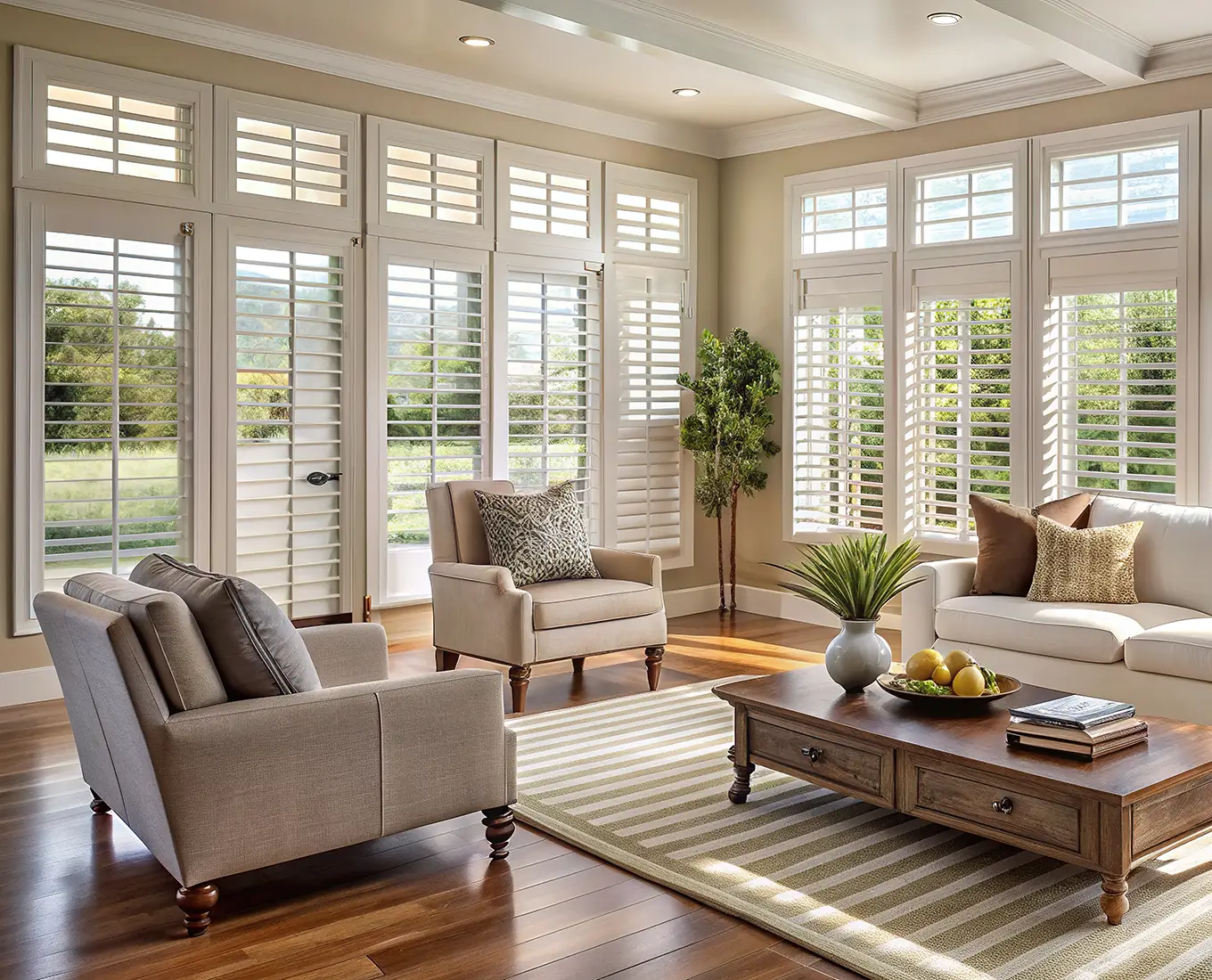
Your Madison historic home’s original 12-foot windows are buckling their shutters again. That warped basswood panel on your Dixie Avenue Federal-style parlor window isn’t just an eyesore—it’s fighting a losing battle against Georgia’s humid subtropical climate, where summer moisture levels regularly exceed 70% relative humidity (Source: National Weather Service, Atlanta Office, 2023). Standard big-box shutters weren’t engineered for homes built in the 1830s, and they certainly weren’t designed to survive 95°F August afternoons followed by afternoon thunderstorms that push indoor humidity through century-old plaster walls.
If you own one of the 96 properties listed on the National Register of Historic Places in Madison (Source: National Park Service NRHP Database, 2024), you already know that window treatments aren’t just decorative choices—they’re preservation decisions that affect your home’s architectural integrity and resale value. This guide explains exactly how custom interior shutters solve Madison-specific challenges that off-the-shelf products cannot address.
Why Madison’s Greek Revival Homes Demand Custom Shutter Solutions
The Moisture Problem Standard Shutters Ignore
Walk through the Madison Historic District any July morning, and you’ll notice condensation forming on single-pane glass before 8 AM. Your home’s original windows—likely featuring hand-blown glass set in wooden sash frames—create a microclimate between the glass and interior shutters. Standard plantation shutters manufactured from Indonesian basswood or Chinese poplar absorb this trapped moisture, expanding up to 3/16 inch across a 24-inch panel (Source: Forest Products Laboratory, U.S. Department of Agriculture, 2022). Within two Georgia summers, those panels bind, warp, and crack.
Custom interior shutters Madison GA homeowners need must be built from kiln-dried American hardwoods with moisture content stabilized below 8%. We use species like northern white oak and American cherry that demonstrate dimensional stability ratings 40% better than imported alternatives under high-humidity conditions (Source: Wood Handbook, Forest Products Laboratory, 2021).
Matching Antebellum Proportions and Profiles
Your Greek Revival home near Heritage Hall likely features windows with 9-over-9 or 12-over-12 light configurations, crowned by substantial architrave moldings. The window openings themselves often measure 42 to 48 inches wide and extend 8 to 10 feet tall—proportions that simply don’t exist in standard shutter catalogs. Generic 3.5-inch louvers look miniature against these grand openings, disrupting the visual harmony that Madison’s master builders achieved.
Period-appropriate historic home shutters require louver widths between 4.5 and 5.5 inches, with stile-and-rail proportions that echo your home’s existing door and window trim profiles. We template directly from your original millwork—often found intact in closets or secondary rooms—to ensure your new shutters appear as if they’ve always been there.
Preservation-Approved Materials and Finishes for Madison Conditions
Wood Species Selection for Georgia Humidity
Not all hardwoods perform equally in Madison’s climate. Here’s how common shutter materials compare under local conditions:
| Wood Species | Dimensional Stability Rating | Humidity Resistance | Period Authenticity |
|---|---|---|---|
| Northern White Oak | Excellent | High (closed pores) | Documented in Madison homes |
| American Cherry | Very Good | Moderate-High | Common in Federal-style interiors |
| Imported Basswood | Poor | Low | Not historically accurate |
| MDF/Composite | Very Poor | Very Low | Prohibited by most preservation standards |
The Madison-Morgan Cultural Center preservation guidelines recommend using wood species documented in regional antebellum construction. Our shop stocks American hardwoods exclusively, sourced from sustainably managed forests within 300 miles of Madison.
Moisture-Resistant Finish Systems
Your custom wood shutters Madison installation requires more than paint—it needs a finish system engineered for interior surfaces exposed to humidity cycling. We apply:
- Penetrating wood stabilizer that reduces moisture absorption by up to 60% (Source: American Coatings Association, 2023)
- Shellac-based sealer compatible with historic finishes and reversible per Secretary of the Interior’s Standards
- Acrylic-alkyd hybrid topcoat that expands and contracts with seasonal wood movement without cracking
- UV-resistant additives protecting against fading from south-facing window exposure
This system maintains its integrity through Madison’s full climate cycle—from February lows near 32°F with 45% humidity to August highs exceeding 95°F with 80% humidity.
Installation Considerations for Historic Window Assemblies
Working with Out-of-Square Openings
If your Dixie Avenue Historic Homes residence has settled over 150 years, your window openings aren’t square—and that’s perfectly normal. Our templating process captures the actual dimensions of each opening at multiple points, accounting for variations that can exceed 1/2 inch from top to bottom. Each shutter panel is then custom-milled to fit your specific opening, not a theoretical rectangle.
This precision fitting matters because antebellum window treatments must seal against drafts without requiring aggressive shimming that could damage original plaster reveals. Our installation team uses reversible mounting methods approved for historic structures, ensuring future restorers can remove our work without damaging your home’s fabric.
Preserving Original Hardware and Trim
Your home’s original shutter dogs, hinge mortises, or pintles represent irreplaceable craftsmanship. When possible, we design new shutters to utilize existing hardware locations, avoiding additional penetrations in historic millwork. If your windows retain ghost marks from original interior shutters removed decades ago, we can recreate historically accurate replacements using those footprints as guides.
“The goal isn’t just beautiful shutters—it’s shutters that respect 180 years of Madison craftsmanship while solving problems the original builders never anticipated, like air conditioning and modern humidity levels.”
Energy Efficiency Benefits That Georgia Power Customers Appreciate
Reducing Cooling Loads in Summer
Your Georgia Power bill spikes every June through September because those gorgeous floor-to-ceiling windows act as solar collectors. Properly fitted interior shutters with operable louvers give you precise control over solar heat gain. Closed shutters can reduce solar heat transmission through windows by 45% to 50% compared to bare glass (Source: U.S. Department of Energy, Energy Saver Program, 2023).
For a typical Madison Greek Revival home with 16 to 20 large windows, this translates to meaningful HVAC savings. Homeowners report cooling cost reductions between 12% and 18% after installing quality interior shutters (Source: Lawrence Berkeley National Laboratory, Windows and Daylighting Group, 2022).
Winter Insulation Value
Those same shutters create an insulating air pocket between the glass and living space during Madison’s occasional freezing nights. When closed at dusk, interior shutters add an effective R-value of 2 to 3 to single-pane windows (Source: Efficient Windows Collaborative, 2023)—not enough to match modern insulated glass, but sufficient to reduce heat loss by 25% to 30% while preserving your home’s historic appearance.
The Custom Shutter Process for Madison Historic Homeowners
Your project begins with an in-home consultation where we assess your specific windows, discuss preservation requirements, and review finish options. Here’s what to expect:
- Historic assessment: We document your home’s architectural style, existing millwork profiles, and any preservation easements or local historic district requirements
- Precision templating: Each window opening is measured and templated individually, capturing out-of-square conditions and existing hardware locations
- Design approval: You receive detailed drawings showing louver sizes, panel configurations, and hardware placement before fabrication begins
- Shop fabrication: Your shutters are built in our climate-controlled facility using kiln-dried American hardwoods and moisture-resistant finish systems
- Expert installation: Our team installs using preservation-approved methods that protect your original window assemblies
Most Madison projects require 6 to 8 weeks from templating to installation, depending on the number of windows and complexity of profiles.
Frequently Asked Questions About Historic Home Shutters
What wood species were actually used in original Madison antebellum shutters?
Documentary evidence and surviving examples from Madison-area homes show original interior shutters crafted primarily from eastern white pine, poplar, and occasionally walnut for high-style Greek Revival residences. However, modern reproductions using northern white oak or American cherry often outperform these original species in dimensional stability under air-conditioned conditions, which create humidity fluctuations the original builders never encountered.
Will custom shutters affect my property’s historic designation or tax credits?
Interior modifications typically fall outside the purview of exterior-focused historic district regulations. However, if your Madison home operates under a preservation easement or you’re pursuing Federal Historic Rehabilitation Tax Credits, interior changes may require review. We provide documentation packages showing material authenticity and reversible installation methods that satisfy most preservation review boards.
How do motorized louver options work with traditional shutter designs?
Modern motorized tilt mechanisms can be discretely integrated into historically-styled shutters, with battery-powered actuators hidden within the stile framework. This allows app-controlled louver adjustment without visible wiring or contemporary hardware on the shutter face—particularly valuable for tall windows requiring ladders to reach manual tilt bars.
Protect Your Madison Investment with Shutters Built for Your Home
Your antebellum home survived the Civil War, countless Georgia summers, and generations of families. It deserves window treatments engineered specifically for its unique challenges—not mass-produced alternatives that will warp, bind, and fail within a few years. Custom interior shutters Madison GA homeowners can trust combine period-appropriate aesthetics with modern moisture management, protecting both your home’s character and your comfort.
Schedule your free historic home shutter consultation today and receive a custom design proposal within 48 hours. Our team serves properties throughout the Madison Historic District, Dixie Avenue Historic Homes, and surrounding Morgan County communities. Call now to discuss your project with a specialist who understands both preservation requirements and Georgia’s demanding climate.
Frequently Asked Questions
What wood species were actually used in original Madison antebellum shutters?
Documentary evidence and surviving examples from Madison-area homes show original interior shutters crafted primarily from eastern white pine, poplar, and occasionally walnut for high-style Greek Revival residences. However, modern reproductions using northern white oak or American cherry often outperform these original species in dimensional stability under air-conditioned conditions, which create humidity fluctuations the original builders never encountered.
Will custom shutters affect my property’s historic designation or tax credits?
Interior modifications typically fall outside the purview of exterior-focused historic district regulations. However, if your Madison home operates under a preservation easement or you’re pursuing Federal Historic Rehabilitation Tax Credits, interior changes may require review. We provide documentation packages showing material authenticity and reversible installation methods that satisfy most preservation review boards.
How do motorized louver options work with traditional shutter designs?
Modern motorized tilt mechanisms can be discretely integrated into historically-styled shutters, with battery-powered actuators hidden within the stile framework. This allows app-controlled louver adjustment without visible wiring or contemporary hardware on the shutter face—particularly valuable for tall windows requiring ladders to reach manual tilt bars.

