
Madison GA’s Brutal Summers Are Draining Your Wallet
When July humidity hits 85% and temperatures climb past 95°F near Lake Oconee, your air conditioner becomes the most expensive appliance in your home. Georgia Power customers in Morgan County routinely see summer electric bills spike $150-200 above spring averages. If you live in Downtown Madison in one of those gorgeous antebellum homes with original single-pane windows, you’re essentially cooling the entire neighborhood.
Here’s the uncomfortable truth: your windows are responsible for 25-30% of residential heating and cooling energy use (Source: U.S. Department of Energy, 2024). That’s not a vague estimate—that’s heat pouring through glass while your HVAC system fights a losing battle. Cellular shades in Madison GA homes provide the critical thermal barrier that standard curtains and basic blinds simply cannot match.
Whether you’re in a newly built Lake Oconee area property or maintaining a historic gem steps from the Morgan County African American Museum, the right window treatments transform your home’s energy profile. This guide shows you exactly how honeycomb technology works, what it costs, and why Madison homeowners specifically benefit from this upgrade.
How Cellular Shades Actually Stop Heat Transfer
The Science Behind Honeycomb Construction
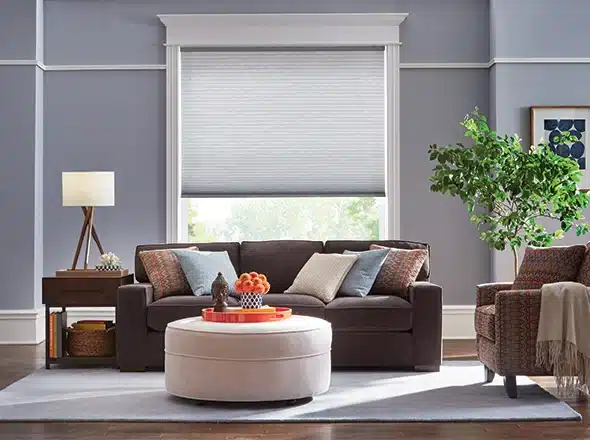
Cellular shades earn their name from the honeycomb-shaped air pockets woven into the fabric. These aren’t decorative—they’re engineered insulation chambers. Each cell traps still air, creating a buffer zone between your window glass and interior living space. Air is a poor heat conductor, so these pockets act like invisible insulation panels mounted directly on your windows.
Single-cell shades provide R-values around 2.0, while double-cell (dual honeycomb) shades reach R-values of 3.0-4.0 (Source: Attachments Energy Rating Council, 2023). For comparison, single-pane windows alone offer R-values under 1.0. You’re essentially tripling or quadrupling your window’s insulation capacity with a single upgrade.
Why This Matters for Madison’s Historic Homes
The Buckhead area Madison neighborhood and Downtown historic district feature stunning 19th-century architecture—tall windows, original glass, zero thermal breaks. Replacing those windows destroys historic character and violates preservation guidelines. Cellular shades solve the energy problem without touching the original construction.
One study found that cellular shades reduce heat gain through windows by up to 80% during summer months when properly fitted (Source: U.S. Department of Energy, Window Coverings Report, 2023). That means your AC runs shorter cycles, your compressor lasts longer, and your Georgia Power bill drops significantly.
Energy Savings You Can Actually Measure
Real Numbers for Madison GA Climate Conditions
Generic window treatment claims don’t account for regional conditions. Madison GA experiences approximately 2,200 cooling degree days annually (Source: NOAA National Centers for Environmental Information, 2023)—that’s the cumulative temperature burden your AC system must overcome. Compare that to 1,400 cooling degree days in Asheville or 1,100 in Boston. Your windows work harder here.
The ENERGY STAR program calculates that properly installed cellular shades reduce home energy bills by up to 25% (Source: ENERGY STAR, Window Attachments Guide, 2024). For a Madison household paying $200/month in summer electric costs through Georgia Power or Walton EMC, that translates to $50 monthly savings during peak season—$200-300 annually.
Key Insight: Homes with south- and west-facing windows in Madison GA see the highest return on cellular shade investment. These exposures receive maximum solar heat gain during afternoon hours when electricity rates peak.
Comparing Your Window Treatment Options
| Window Treatment | R-Value | Heat Reduction | Best For |
|---|---|---|---|
| Cellular Shades (Double-Cell) | 3.0-4.0 | Up to 80% | Energy efficiency + light control |
| Cellular Shades (Single-Cell) | 2.0 | Up to 60% | Budget-conscious upgrades |
| Standard Roller Blinds | 0.5-1.0 | 20-30% | Basic privacy only |
| Drapes/Curtains | 0.5 | 10-25% | Decorative use |
| Wood Blinds | 1.0 | 25-35% | Traditional aesthetics |
Choosing the Right Cellular Shades for Your Madison Home
Cell Size and Light Filtering Options
Cellular shades come in three standard cell sizes: 3/8-inch, 9/16-inch, and 3/4-inch. Larger cells provide greater insulation but appear more casual. For Madison GA’s historic Greek Revival and Federal-style homes around Madison Town Park, 9/16-inch cells strike the ideal balance—substantial energy performance without overwhelming traditional window proportions.
You’ll also choose between light-filtering and room-darkening fabrics:
- Light-filtering: Softens glare while maintaining natural light—ideal for living rooms and kitchens
- Room-darkening: Blocks 99% of light—perfect for bedrooms and media rooms
- Day/night combinations: Two shades on one headrail for versatility
Color Selection for Madison’s Architectural Styles
Energy efficient window treatments in Madison GA must complement both function and aesthetics. The warm whites and soft creams that suit Downtown Madison’s antebellum interiors differ dramatically from the cool grays and bold neutrals that work in Lake Oconee area contemporary builds.
Consider these guidelines:
- Historic homes: Warm whites, alabaster, linen tones that mimic traditional window dressings
- Modern construction: Cool grays, charcoals, or bold accent colors that create contrast
- Lake-view properties: Blue-grays and sage greens that connect interior and exterior palettes
Mounting Styles and Measurement Precision
Inside-mount installation fits within your window frame for a clean, built-in appearance—essential for Madison’s historic homes where you want to showcase original millwork. Outside-mount installation covers the entire window opening and extends beyond the frame, maximizing light blockage and energy savings.
Accurate measurements determine everything. A shade that’s 1/4-inch too narrow creates gaps that leak conditioned air. Professional measurement ensures your insulating blinds Georgia homeowners trust actually perform as specified.
Installation Considerations for Madison Properties
Single-Pane Windows in Historic Districts
If your Buckhead area Madison or Downtown property features original single-pane windows, cellular shades become even more critical. These windows offer virtually no thermal resistance. Adding double-cell honeycomb shades transforms performance without the $500-800 per window cost of replacement.
For properties near the Morgan County African American Museum and other historically significant structures, preservation guidelines often restrict exterior modifications. Interior cellular shades remain fully compliant while delivering measurable energy improvements.
New Construction and Energy Code Compliance
Newer Lake Oconee area homes typically feature double-pane low-E windows. You might assume additional window treatments are unnecessary. However, even modern windows transfer significant radiant heat. The National Fenestration Rating Council reports that window coverings can reduce solar heat gain coefficient by an additional 30-40% beyond glass alone (Source: NFRC Technical Document, 2022).
Georgia’s energy code continues tightening. Installing high-performance cellular shades now positions your home above minimum standards—a selling point when Lake Oconee area properties command premium prices.
Why Madison GA Homeowners Trust Local Installation
The tech-savvy homeowners throughout Madison understand that product quality means nothing without proper installation. Generic big-box measurements often miss critical details: window frame depth, operational clearance, and mounting surface condition.
Local expertise matters for several reasons:
- Climate-specific recommendations: Understanding that south-facing windows near Lake Oconee need different solutions than shaded north-facing windows Downtown
- Architectural sensitivity: Knowing which mounting approaches preserve historic trim versus which damage irreplaceable millwork
- Utility rebate awareness: Tracking Georgia Power and Walton EMC incentive programs that offset installation costs
- Warranty support: Providing local service rather than forcing you through national call centers
Your investment deserves professionals who’ve actually worked in Madison GA homes—not contractors reading generic installation scripts.
Schedule your free energy assessment and cellular shades quote to see exactly how much you’ll save on your Georgia Power or Walton EMC bills.
Frequently Asked Questions About Cellular Shades in Madison GA
What makes cellular shades better than plantation shutters for Madison’s climate?
Plantation shutters offer solid light control but minimal insulation value—their R-value rarely exceeds 1.5. In Madison GA’s extreme summer humidity and heat, the trapped air pockets in cellular shades provide R-values of 3.0-4.0 with double-cell construction. This means your AC unit cycles less frequently during those 95°F afternoons common near Lake Oconee and throughout Morgan County. Shutters also require significant frame modifications to historic windows, while cellular shades install without altering original construction.
How long do quality cellular shades typically last in Georgia’s humidity?
Premium cellular shades with moisture-resistant fabrics last 10-15 years with normal use in Madison GA conditions. The key factors affecting longevity include fabric quality, UV exposure intensity, and operational frequency. South-facing windows near Madison Town Park receive more UV degradation than shaded positions. Manufacturers like Hunter Douglas and Graber offer 5-7 year warranties on materials. Avoid bottom-tier products from discount retailers—they deteriorate within 3-4 years in Georgia’s climate, negating any upfront savings.
Can I automate my cellular shades to maximize energy savings automatically?
Modern motorized cellular shades integrate with smart home systems through Wi-Fi, Zigbee, or Z-Wave protocols. You can program shades to lower automatically when exterior temperature sensors detect peak heat—typically 2-5 PM during Madison summers. Integration with Georgia Power’s smart meter data allows shades to respond to real-time demand pricing. Battery-powered motors eliminate wiring concerns in historic Downtown Madison homes where running electrical would damage plaster walls. Expect motorization to add $150-300 per window but recover the cost through optimized energy timing within 2-3 years.
Get Your Free Madison GA Energy Assessment
Every window in your Madison home presents an opportunity to reduce energy waste. Whether you’re managing a historic property near the Morgan County African American Museum, a lakefront retreat in the Lake Oconee area, or a family home in Buckhead area Madison, cellular shades deliver proven performance that shows up on your Georgia Power or Walton EMC statement.
Stop paying to cool the outdoors. Request your free energy assessment and cellular shades quote today. We’ll measure your windows, analyze your sun exposure patterns, and provide specific savings projections for your Madison GA home—no obligation, no pressure, just actionable information you can use.
Frequently Asked Questions
What makes cellular shades better than plantation shutters for Madison’s climate?
Plantation shutters offer solid light control but minimal insulation value—their R-value rarely exceeds 1.5. In Madison GA’s extreme summer humidity and heat, the trapped air pockets in cellular shades provide R-values of 3.0-4.0 with double-cell construction. This means your AC unit cycles less frequently during those 95°F afternoons common near Lake Oconee and throughout Morgan County. Shutters also require significant frame modifications to historic windows, while cellular shades install without altering original construction.
How long do quality cellular shades typically last in Georgia’s humidity?
Premium cellular shades with moisture-resistant fabrics last 10-15 years with normal use in Madison GA conditions. The key factors affecting longevity include fabric quality, UV exposure intensity, and operational frequency. South-facing windows near Madison Town Park receive more UV degradation than shaded positions. Manufacturers like Hunter Douglas and Graber offer 5-7 year warranties on materials. Avoid bottom-tier products from discount retailers—they deteriorate within 3-4 years in Georgia’s climate, negating any upfront savings.
Can I automate my cellular shades to maximize energy savings automatically?
Modern motorized cellular shades integrate with smart home systems through Wi-Fi, Zigbee, or Z-Wave protocols. You can program shades to lower automatically when exterior temperature sensors detect peak heat—typically 2-5 PM during Madison summers. Integration with Georgia Power’s smart meter data allows shades to respond to real-time demand pricing. Battery-powered motors eliminate wiring concerns in historic Downtown Madison homes where running electrical would damage plaster walls. Expect motorization to add $150-300 per window but recover the cost through optimized energy timing within 2-3 years.

